Cosmetic Glass Bottle Recyclability Grades in Korea: Setting Color, Decoration and Components at the Spec Stage
2026-10-28
In Korea, the recyclability grade of a cosmetic glass bottle is set by the Standard for Grading Recyclability of Packaging Materials (a Ministry notice). A bottle whose body is colorless, brown or green, and whose label, closure and components can be separated from it, is rated "Excellent"; other body colors or parts that cannot be separated lead to "Poor". Color, decoration, labels and components are all decided when the container is specified, so the brand that applies for the grade (the ordering brand in OEM production) should review these rules while agreeing the specification with its container maker. JeongwooCos runs consultation, design and mold review, sampling, decoration, inspection and component assembly, and turns the brand's chosen color, decoration and component set into a specification. This article covers the grading rules, the labeling duty, and what is checked at each stage when working with JeongwooCos.
Body color and separable parts decide a glass bottle's grade
1. Which grades can a cosmetic glass bottle receive?
There are four grades: Best, Excellent, Normal and Poor. Best is limited to PET bottles and PSP, so the highest grade a glass bottle can receive is Excellent. The body, label, closure and miscellaneous parts are each assessed, and the least favorable item sets the result.
| Component | Toward Excellent | Toward Poor | What to check in the spec |
|---|---|---|---|
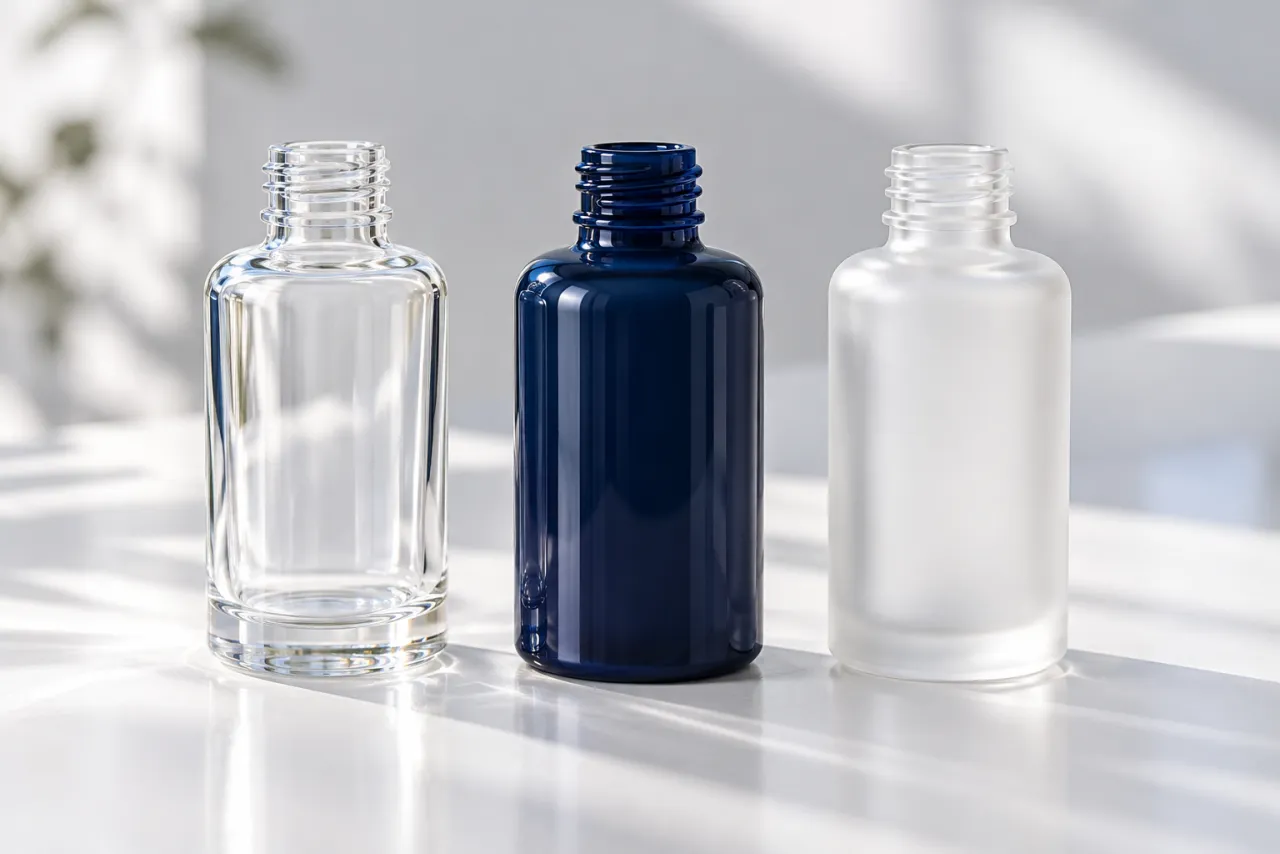
| Body color | Colorless, brown, green | Any other color (blue, black, opal, etc.) | Color is judged visually or by instrument; a color produced by coating is judged by how it looks. |
| Label | No label, paper label, separable plastic label | Glued plastic label that cannot be removed | For glued labels, separability and a separation instruction decide Excellent, Normal or Poor. |
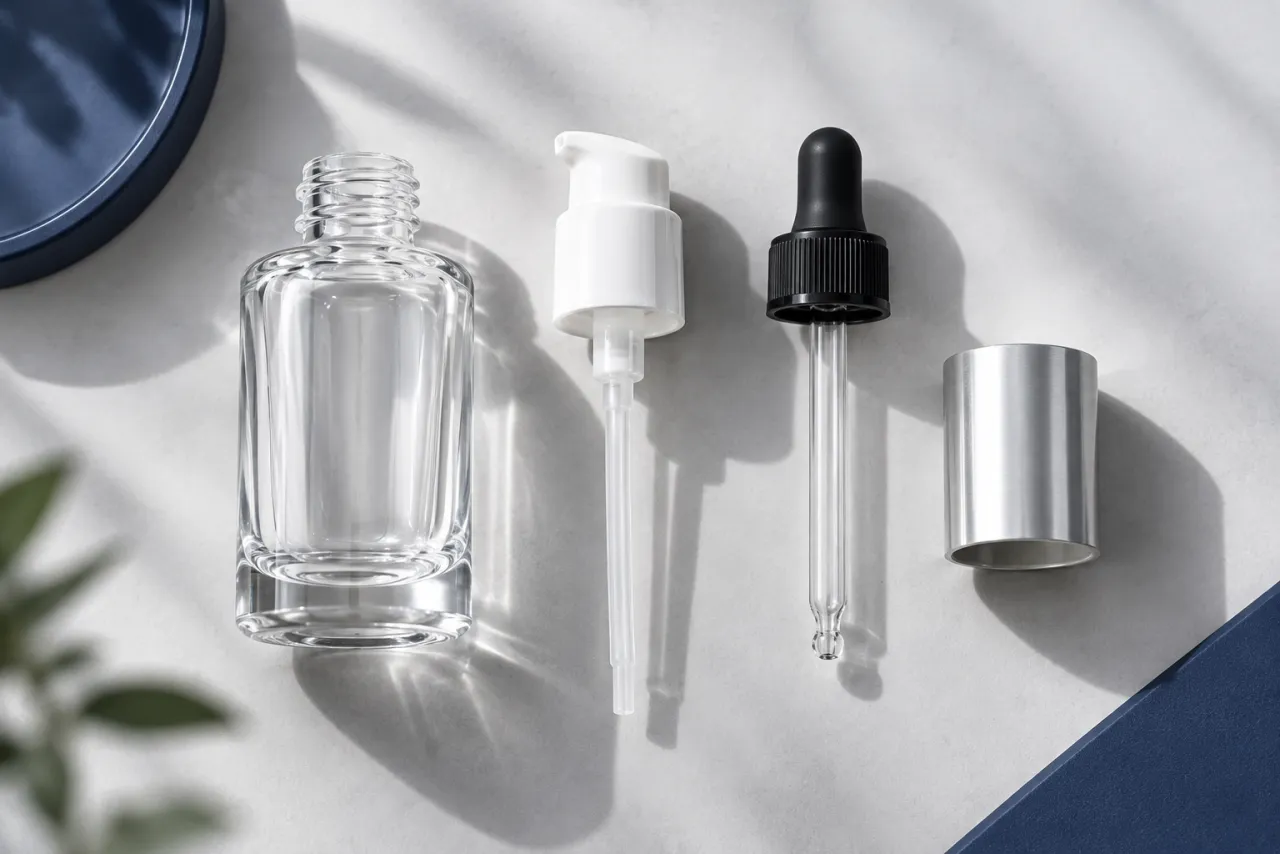
| Closure and parts | Easily separated from the body | Metal closures overlaid with plastic; closures or parts that cannot be separated | Check that pumps, droppers, caps and inner caps can be removed by hand. |
This table summarizes the notice, the public-agency FAQ and related research. The final grade is the one issued by Korea Environment Corporation.
2. Do color coating or frosting affect the grade?
Because color is judged visually or by instrument, a coating that produces a color other than colorless, brown or green can lead to a Poor rating. In the Korea Cosmetic Association's Q&A, bottles coated green or brown are graded by the color they are judged to be, and lots that fall outside those colors count as a different material structure that needs its own application.
- If the brand color is blue, black or pink, compare partial printing or carrying the color on the outer carton against full-body coating.
- If brown or green comes from coating, agree on lot-to-lot color tolerance at the quotation stage.
- Ask the agency before applying how a finish that adds no color, such as frosting, is judged.
How JeongwooCos handles it: decoration consultation
JeongwooCos offers frosted-look coating, color coating, vacuum metallization (PVD), silk screen and pad printing, hot stamping and gradient coating. Tell us the texture, color and print combination you want and that the recyclability grade matters, and we compare processes that express color differently, such as printing or foil instead of full-body coating, and propose a suitable one. Decoration samples show the actual color and texture, and in production a spectrophotometer keeps batch-to-batch color variation within ΔE*ab ≤ 1.0.
See the surface finishing guide and quality assurance for each process.
Coating options are also compared in Color Coating vs PVD vs Frosting and Decoration Before vs After.
3. How are pumps, droppers and caps assessed?
Closures and parts that separate easily from the glass body do not count against the bottle, but parts that cannot be separated, or metal closures overlaid with plastic, are rated Poor. The agency FAQ treats handles, lids and tamper-evident stickers attached to the body as miscellaneous parts assessed under the body's rules.
- List the material of each component: pump body, dropper rubber bulb, glass pipette, cap shell and inner cap.
- Check that a consumer can separate each one from the bottle by hand after use.
- Check whether a metal cap shell has a plastic overlay.
- If an inner cap or ring stays on the bottle neck, get a quote for an alternative component as well.
How JeongwooCos handles it: component materials
JeongwooCos designs and verifies the materials and fit of each dropper and pump part, and publishes the material of every part. A color dropper, for example, combines a rubber bulb (silicone/NBR), a cap and collar (PP with color coating), an inner packing (LDPE) and a glass pipette (soda-lime); a metal dropper's collar and cap are ABS with aluminum metallizing. Because we combine bottles with caps, pumps and droppers and deliver them assembled, a brand can get the part-by-part material list it needs for the application from one container maker.
See the parts anatomy guide for each structure and Dropper vs Pump vs Cap for component types.
The brand applies and labels; the container spec is the evidence
4. Who applies for the grade, and when must it be shown?
The obligated producer under the Act on the Promotion of Saving and Recycling of Resources applies; in OEM production that is the ordering brand owner. A Poor grade must appear on the packaging within six months of receiving the result, while showing Normal or better is optional.
| Item | Rule |
|---|---|
| Applicant | The obligated producer; in OEM production, the ordering brand owner |
| Unit | One application per material structure; one representative item covers all capacities with the same structure |
| Labeling | Poor must be shown within 6 months of the result (up to 9 months with an extension); Normal or better is optional |
| Exemptions | Packaging exempt from the separation mark, such as contents of 30ml (30g) or less or a surface under 50cm², may omit the grade mark, but must still be assessed |
| Cost | Poor-grade packaging carries a 10-20% surcharge on the recycling contribution (2022 basis) |
| Penalty | Up to KRW 3 million for skipping the assessment or the mark |
| Exports | Products and packaging made or imported for export are not assessed |
Serums and ampoules of 30ml or less may skip the mark but still need the assessment, which is easy to miss. One study found that 28.1% of glass bottles shipped in 2021 (by weight) were graded Poor, so checking the grade during specification saves both cost and schedule.
5. What should you ask the container maker for?
Applications rely on documents that show the material structure, such as test reports or the packaging maker's reports, order specifications and delivery confirmations, plus photos of the packaging. Ask for these at the quotation stage.
- Glass body color (colorless, brown or green) and any coating or printing
- Material of each component: pump, dropper, cap, inner cap
- Label specification: paper or plastic, and how it is attached
- Photos showing how each component separates from the bottle
Where the recyclability grade is reviewed when working with JeongwooCos
JeongwooCos production runs in six stages: consultation and requirements, design and mold review, sample production, mass production, quality inspection, and packaging and delivery. The specs that decide the grade are set early, so checking the items below at each stage gathers the application evidence along the way.
| Stage | What JeongwooCos does | What to check for the grade |
|---|---|---|
| Consultation and requirements | Confirms capacity, shape, quantity, delivery date and brand concept; proposes a standard container or custom development | Body color (colorless, brown or green), planned decoration, components to be used |
| Design and mold review | Prepares drawings, reviews existing or new molds, checks shape and fit with 3D-printed prototypes | Label position and attachment, how components separate from the bottle |
| Sample production | Basic sample (shape, capacity, neck, compatibility), decoration sample (color, print, coating, foil), approval sample (production standard) | Visible color on the decoration sample, component separability, packaging photos for the application |
| Quality inspection | Inspects appearance, dimensions, cap compatibility and print durability; tracks batch color with a spectrophotometer | Coated color staying within the reference color lot to lot |
| Packaging and delivery | Delivers with caps, pumps or droppers assembled; packs safely and ships | Keep the assembled component and material list as specification evidence |
See manufacturing process, sample policy and OEM/ODM scope for details. For the EU side, see EU PPWR and glass packaging.
Frequently asked questions
Is a clear glass bottle always rated Excellent?
No. A colorless body can still be rated Poor if it carries a plastic label that cannot be removed or a closure or part that cannot be separated. Check the body, label, closure and parts together.
Does a 30ml serum bottle need a recyclability assessment?
Yes, if the business is an obligated producer. Contents of 30ml or less are exempt from the separation mark, so the grade mark can be omitted, but the duty to apply remains.
Are 30ml and 50ml bottles of the same design assessed separately?
Not if the material structure is the same; one representative item covers both. A different color or component set counts as a different structure and needs its own application.
Does JeongwooCos decide the recyclability grade?
No. The grade comes from Korea Environment Corporation's assessment, and the brand applies. JeongwooCos sets out the specs that affect it, such as body color, decoration and the material of each component, during consultation and sampling, and compares decoration processes that fit the look you want.
References
- Standard for Grading Recyclability of Packaging Materials - Korean Law Information Center
- Packaging material and structure assessment FAQ - Korea Environment Corporation
- Cosmetics resource circulation Q&A - Korea Cosmetic Association
- Alternative technologies for improving packaging recyclability grades - Korean Journal of Packaging Science & Technology
Settle a recyclability-aware spec at consultation
Include the product group (bottle, jar, components), capacity, quantity, preferred color and decoration, planned components, and whether the recyclability grade matters. JeongwooCos compares standard containers with decoration and component combinations and sets out what to confirm with samples. Request a sample or quote

