
Excludes reuse, travel use, retail, cleaning, sanitizing or recycling; maps brand needs to new B2B glass body, neck, closure, finish, quantity and timing specs.
Why the search term for used cosmetic bottles does not match real order specs
Many brand staff type consumer search terms for empty cosmetic bottles even when they are actually looking for new packaging. That phrasing is normally used in the context of reusing a leftover container or decanting it for travel, so passing it along unchanged to a manufacturer or distributor fails to communicate the intent to order newly manufactured packaging.
What a buyer actually needs is not a single finished product but a combination of several components that together make up one usable pack. The glass body, the cap or pump, the dropper, and the inner liner are each separate parts, and a usable pack only exists once these parts match each other's specifications. Because a single search phrase cannot describe this whole combination, it helps to break the inquiry into component-level specs from the very first message.
Even with the same search phrase, the actual component combination a brand needs can vary. Some brands have already fixed a glass body with a given neck finish and are only reviewing closures, while others are deciding on the body and closure together from the start. Either way, preparing a document organized by concrete specification fields instead of a search phrase lets the discussion with the supplier narrow down much faster. The same principle applies broadly whenever a brand is specifying new cosmetic glass containers for an order, not only for this one bottle size.
The glass body is a separate part from the cap, pump, dropper, and liner
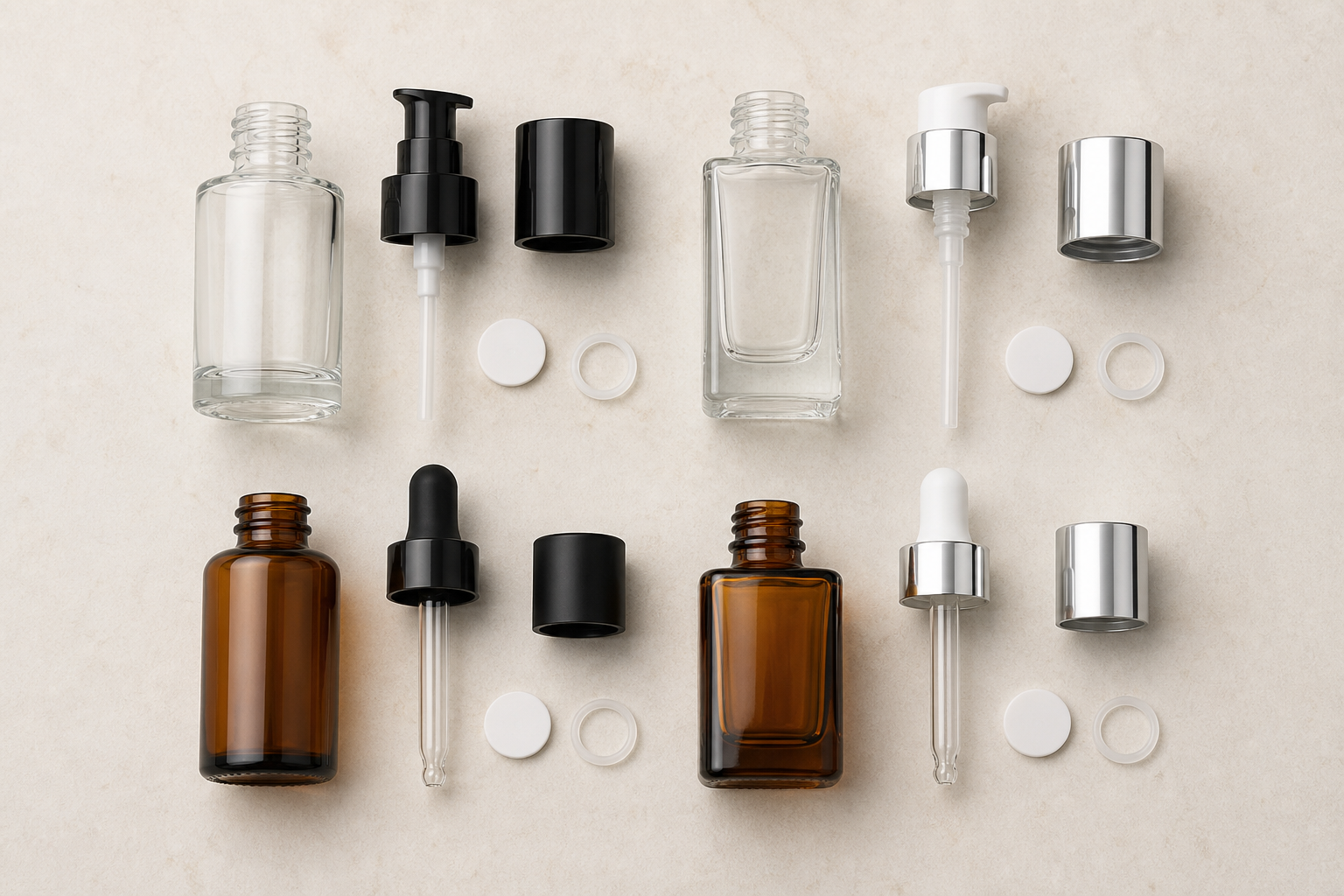
The glass body is defined by fill volume, neck finish, color, and surface treatment. The cap, by contrast, is defined by its closure method and material; the pump by dip-tube length and dose per actuation; the dropper by pipette length and bulb material. The inner liner or gasket is a separate part responsible for sealing performance, and it only works properly when it matches the neck finish.
If you want to check the naming and specification system for these parts first, the parts anatomy guide is a good place to learn how to distinguish the glass body from the closure components. If the parts do not match, you end up with several individual pieces that do not fit together rather than a finished pack, so it is worth confirming compatibility before anything else.
That said, for any two parts under review, matching neck diameter alone does not prove that they actually fit together. Beyond diameter, the neck finish and thread profile, the cap or pump's closure structure, the liner or gasket's thickness and material, and, for a dropper, the dip-tube or pipette length and diameter all need to line up as applicable, and nominal spec numbers alone cannot settle whether a candidate combination truly connects. That can only be confirmed when the brand and the packaging supplier check the actual proposed components and samples together. A common mistake is assuming that matching diameter numbers alone guarantee a fit; if the thread profile or closure structure differs, the parts often fail to assemble even when the diameter matches.
How to turn a vague search phrase into precise specification fields

The table below maps common consumer search phrasing to the specification fields actually needed for an order, and to the information a buyer should prepare before making an inquiry.
| Ambiguous search phrase | Precise pack component / spec field | Information the buyer must supply |
|---|---|---|
| Empty cosmetic bottle | New glass body specification | Fill volume (ml), neck finish, glass color |
| Lid | Cap / closure specification | Closure method (screw or snap), cap material, neck finish match |
| Pump | Pump dispenser specification | Dip-tube length, dose per actuation (cc), neck finish |
| Dropper tool | Dropper assembly specification | Glass pipette length, bulb material, graduation markings |
| Inner seal / liner | Liner / gasket specification | Material (PE, aluminum, etc.), sealing method |
| Surface finish | Glass surface treatment specification | Coating, frosting, silkscreen or other treatment and color |
| Order quantity | Quantity / lead-time confirmation item | Must be confirmed directly with JeongwooCos; this guide does not state a quantity or lead time |
As the table shows, one consumer search phrase actually splits into several distinct component spec fields. Sorting out, before you send an inquiry, which items you have already decided and which are still open makes the conversation with the supplier far more concrete. You do not need to fill in every cell on the first message; following the table's structure alone helps the supplier grasp what you need much faster. You can also copy this table into your own document template and fill it in as each specification is finalized.
Turning "looking for a 30ml empty bottle" into a usable inquiry
Before: "Looking for a 30ml empty bottle."
This sentence contains no information beyond fill volume, leaving the supplier unable to tell whether glass color, neck finish, cap style, or the need for a pump should be confirmed first.
After: Breaking the request into fields below lets you move the inquiry forward while explicitly leaving undecided items open.
- Fill volume: 30ml
- Glass color: undecided between clear and amber, to be finalized after checking samples
- Neck finish: undecided, to be narrowed down with reference to the parts anatomy guide
- Cap style: undecided between screw and snap
- Dispensing method: undecided; cap, pump, and dropper candidates will be compared at the sample stage
- Surface treatment: undecided, to be discussed later based on brand concept
Leaving undecided items visible rather than hiding them makes it easier for the supplier to know which samples and options to offer first, and it cuts down on unnecessary rounds of back-and-forth. An inquiry that clearly states what is still unknown moves to the next step faster than one that forces in placeholder answers just to look complete. From the supplier's side, seeing an item marked as undecided makes it immediately clear what alternative to propose, which reduces the number of round trips needed.
Pre-order verification checklist
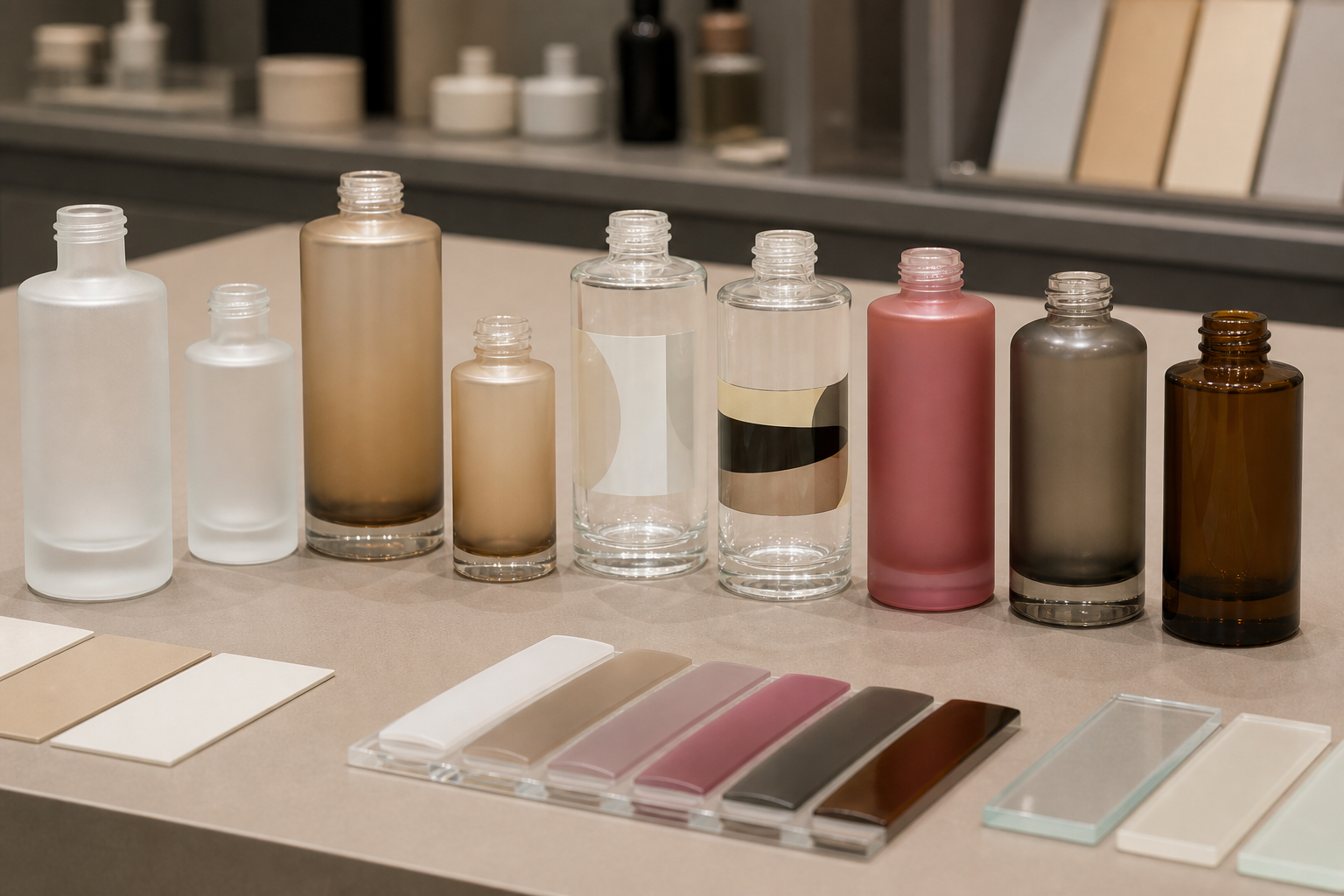
When organizing pack specifications, it helps to check the following items component by component.
- Glass body: fill volume, neck finish, color, surface treatment
- Closure: which combination of cap, pump, or dropper is needed
- Liner / gasket: sealing method and material
- Neck finish compatibility: for the proposed body and closure combination, whether they match not only in diameter but also in neck finish, thread profile, and closure structure
- Sample verification plan: which items the brand and packaging supplier will jointly check on a physical sample of the candidate combination before actual assembly and formula filling
Running through this checklist before an inquiry lets you separate the information you can hand to the supplier from what is still undecided. Neck finish compatibility is easy to check only by diameter and stop there, so it is worth arranging for the brand and supplier to jointly examine a physical sample of the candidate components, covering thread profile and closure structure as well. Following the checklist in order also reduces the chance of sending an inquiry that leaves out a component entirely.
Why doesn't a single search phrase make a complete inquiry?
A search phrase is only a familiar way of expressing a need; it doesn't carry a component-level specification system. The same phrase can mean a different neck finish, color, and closure combination depending on the brand, so filling in component-level spec fields instead of the search phrase communicates far more precisely.
Should I wait to inquire until every item is decided?
No. As in the example above, sending an inquiry with undecided items clearly marked lets the supplier propose options for those items first. Separating what you know from what you don't and sharing that early moves things to the next step faster than waiting until every specification is finalized.
If you want to see the shapes and specification ranges first, review example glass body and closure combinations on the product specification page, then, for checking a candidate combination against a physical sample, see the sample verification process guide to plan your next step.
Once you have organized your component-level specifications, reach out through the JeongwooCos contact page and share your inquiry with the undecided items still included, to check the next step.

