Serum Bottle 30ml vs 50ml Selection Guide | JeongwooCos, Cosmetic Glass Container Maker
2026-04-29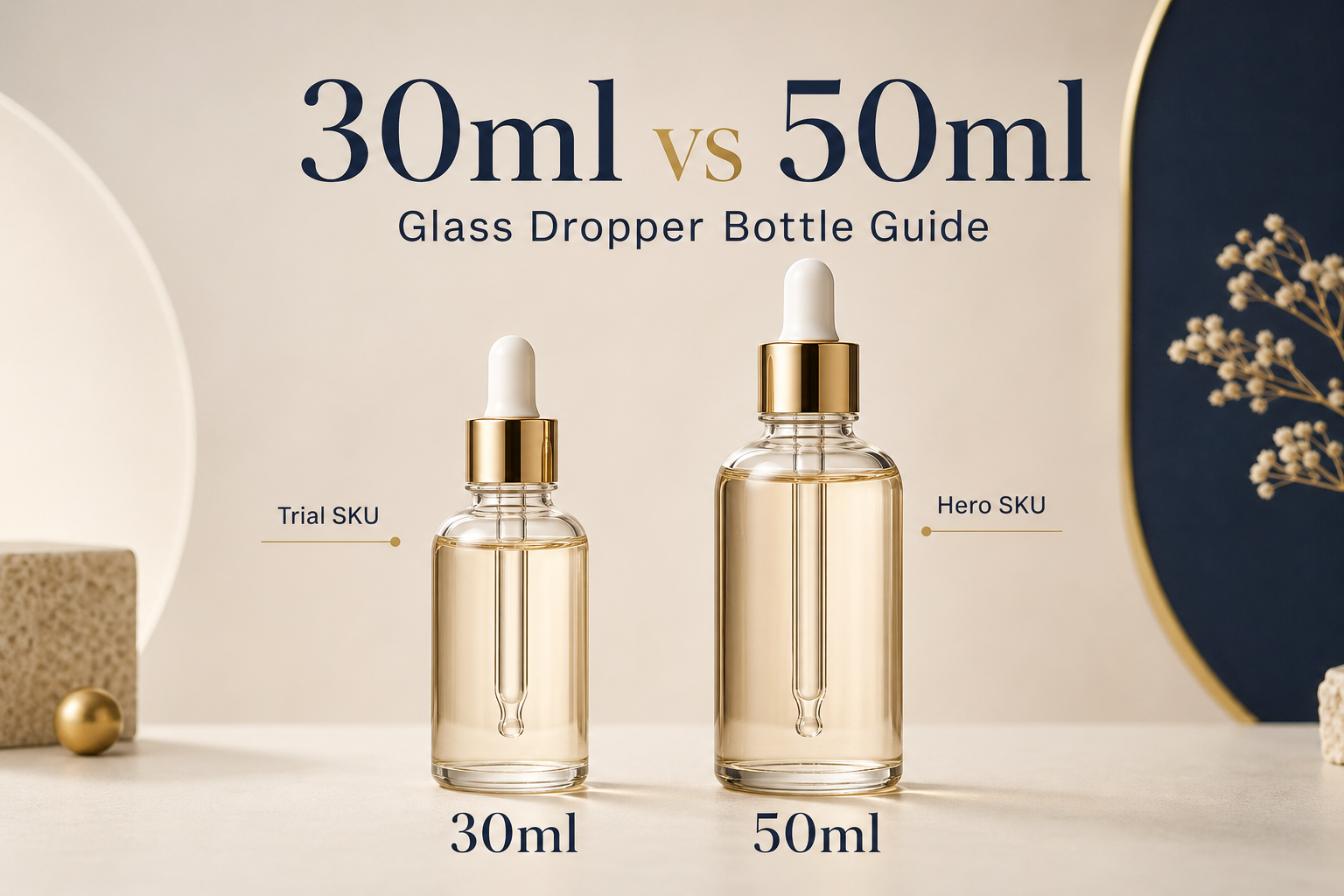
Why Serum Brands Get Stuck Between 30ml and 50ml
One of the most frequent questions we hear from cosmetic brands preparing a serum launch is "should we go with 30ml or 50ml?". Even with the same formula and the same outer design, a single change in capacity reshapes the sales channel mix, unit economics, inventory turnover, first-order quantity, and ad ROAS. This article is a scenario-driven guide written from JeongwooCos's perspective after a decade of cosmetic glass packaging manufacturing — not a generic comparison, but a working playbook for how to pick the right capacity by brand stage, channel, and SKU strategy. For general OEM theory we refer to our standalone guides; here we focus on the decisions that actually surface right before purchase orders are signed.
Bottom line: 30ml and 50ml are not "small" and "large" versions of the same product. They are two distinct markets with different purchase motives, and modern serum brand manufacturing increasingly treats them as a paired dual-SKU rather than a single sized variant. A glass dropper bottle lineup designed for both 30ml and 50ml from day one will save months of mold and packaging rework later.
1. The 30ml Glass Dropper Bottle — Trials, High-Concentration, Gifting
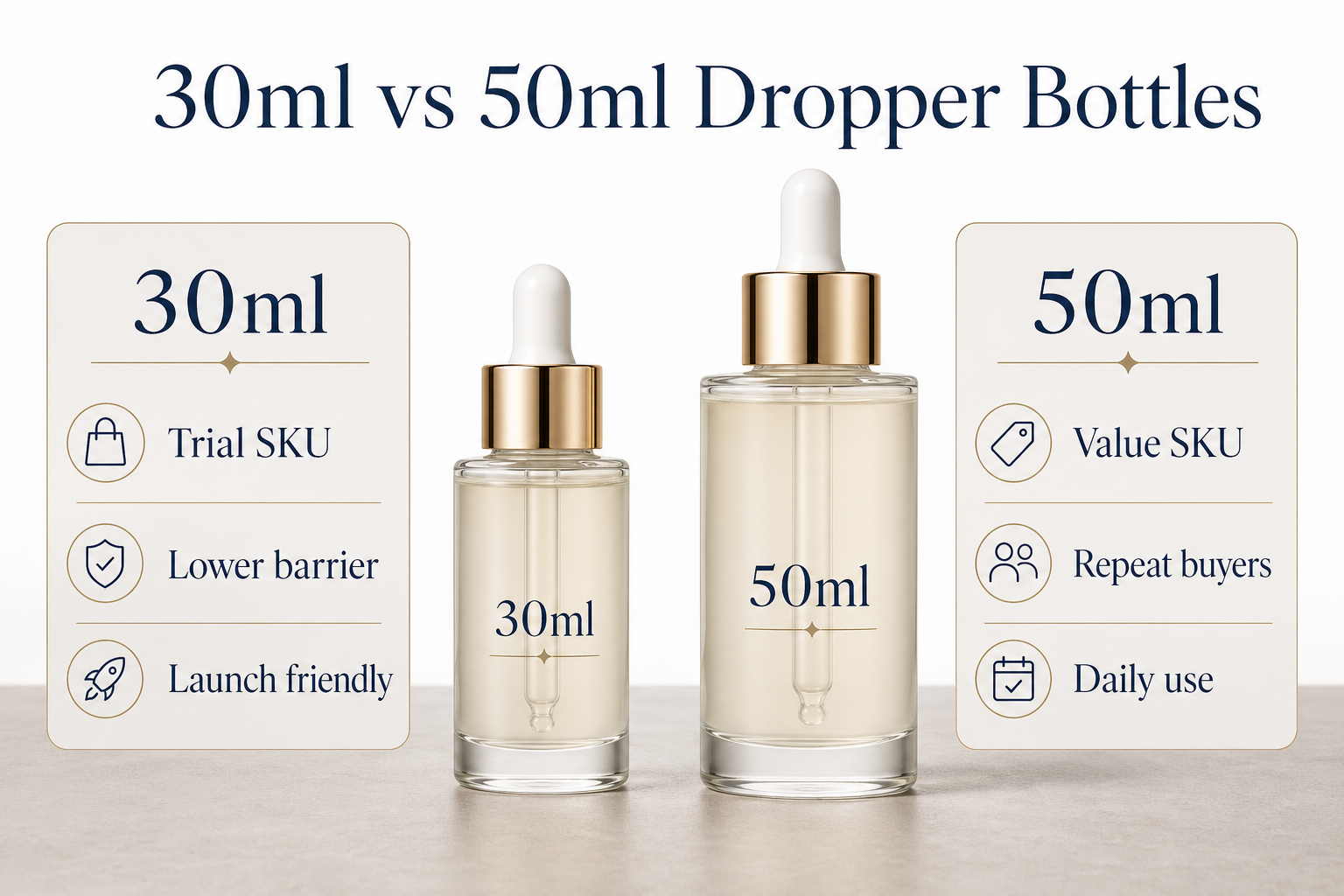
30ml is the most universal capacity in the global serum market. From luxury skincare houses to indie brands, more than half of all first-launch SKUs start at 30ml. The reasons are structural rather than stylistic.
- Psychological price ceiling: at the same per-ml unit cost, a 30ml serum bottle sits one price tier below 50ml, which lifts first-purchase conversion. The gap between a $35 and a $55 checkout absorbs more than 1.5x the average ad CPC overhead.
- Trial-friendly footprint: 30ml represents 4–6 weeks of usage, which is the sweet spot for review programs, influencer seeding kits, and travel-retail bundles. It is the smallest size that does not get "abandoned" before users form an opinion.
- High-concentration formula fit: retinol, ascorbic acid derivatives, peptides, exosome complexes, and bacteriocin-based actives all degrade quickly after opening. 30ml encourages the user to finish the bottle before efficacy drops, which protects the brand from negative "didn't work" reviews caused by oxidized leftovers.
- Logistics efficiency: more 30ml units fit per master carton, lowering per-unit air freight and last-mile shipping for direct-to-consumer cross-border channels. Air freight bills by volumetric weight, not by milliliters of formula.
Within JeongwooCos's catalog, the 01S30 series (round, 18mm/20mm standard neck) and 02S30 series (square, Φ18 neck with metal-collar dropper) are the two most common 30ml workhorses. Both use standard threaded necks rather than wide-mouth openings, so they are interchangeable with gold, silver, and lorette metal droppers — the configurations that anchor the $50–$100 retail price band typical of premium serums.
2. The 50ml Glass Dropper Bottle — Repeat Purchase, Hero SKU, Daily Routine
50ml, on the other hand, targets the post-trial repeat purchase market. Consumers consistently perceive a single 50ml as cheaper than buying 30ml twice, and any daily-use serum applied morning and evening defaults to a 50ml hero SKU.
- Per-ml margin advantage: for the same formula and dropper configuration, a 50ml serum bottle reduces per-ml COGS by roughly 20–30%, which gives finance teams flexibility for promotions, bundles, and subscription pricing.
- Subscription & retention fit: at 8–12 weeks of usage, 50ml fits naturally into monthly or bi-monthly auto-replenishment cadences. The user finishes one bottle just as the next charge clears, which sustains MRR without churn spikes.
- Retail shelf presence: in department stores and health-and-beauty chains, the visual mass of a 50ml bottle reads as the "face" of the line. A 30ml-only display can look like a sampler set on a competitive shelf.
- Cleaner ad payback: a higher AOV simplifies LTV modeling for Meta and Google performance campaigns. With 50ml, first-order break-even arrives faster, which lets brands scale paid acquisition without burning runway.
JeongwooCos's 50ml lineup is centered on the 20mm standard neck (20/410). Models such as 01S50-03/04/07/10/11 freely accept metal-collar, lorette, and injection droppers, while signature design bottles like JW OGE 50, JWD Lumi Square 50, and JWD Lumi Round 50 share Φ20 dropper compatibility, allowing brands to expand a hero lineup without commissioning new tooling. For neck-and-dropper compatibility tables, see our components & anatomy guide.
3. Decision Matrix — 30ml vs 50ml at a Glance
The table below condenses the comparison fields that come up most often during pre-order calls. Use it as a starting reference when you need to align marketing, ops, and finance on a single capacity decision.
| Dimension | 30ml dropper | 50ml dropper |
|---|---|---|
| Primary role | Trial, gifting, high-concentration | Daily hero SKU, subscription, refill |
| Standard neck | 18/415 or 20/410 | 20/410 (Φ20 default) |
| Per-ml cost | Higher (dropper cost is identical) | 20–30% lower |
| Recommended AOV | $25–$80 | $45–$130 |
| Strongest channel | D2C, travel retail, influencer seeding | Multi-brand retail, subscription, B2B wholesale |
| Repurchase cycle | 30–45 days | 60–90 days |
| Best-fit formulas | Retinol, vitamin C, peptides, boosters | Hyaluronic, PDRN, collagen, daily essences |
4. Channel-by-Channel Playbook — Where You Sell Decides the Size
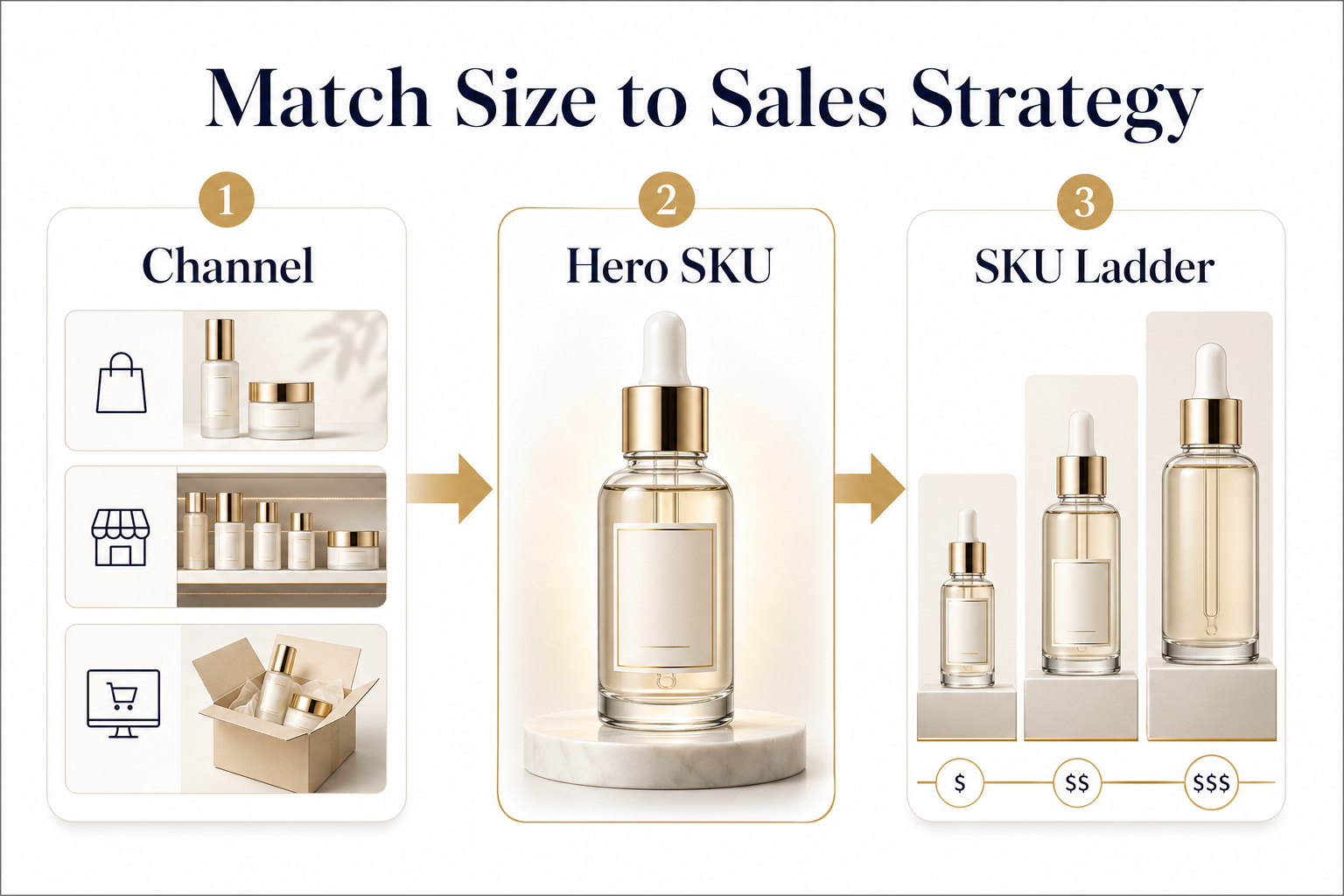
In practice, the channel mix decides the capacity more often than the formula does. The patterns below come up in nearly every B2B serum launch we have manufactured.
- D2C and brand-owned launches: start with a single 30ml SKU to keep paid acquisition CAC manageable, then layer 50ml as a "reorder SKU" once the first 1,000 orders confirm the audience.
- Multi-brand beauty retail (Sephora, Ulta, Olive Young): lead with 50ml as the hero, position 30ml as a limited or set-only SKU. Shelf economics and category planograms favor the larger bottle.
- Travel retail and duty-free: 30ml or 30ml + 30ml dual kits clear the 100ml liquid restriction while keeping AOV high. Travel-retail operators specifically prefer 30ml kits because the per-square-meter sell-through outperforms 50ml singles.
- EU and North American export: separate daily serums (50ml) from booster or ampoule positioning (30ml). Under the EU PPWR regime, a refill cartridge plus 50ml hero bottle combination is becoming a meaningful differentiator on shelf.
- China and Southeast Asia wholesale: 50ml dominates as the standard hero SKU, but live-commerce hosts on Douyin and Kuaishou consistently use 30ml as the entry hook before closing on 50ml — so dual SKUs perform measurably better here.
- Pharmacy and clinic channels: 50ml is almost universal because clinicians prescribe in 8–12 week treatment cycles that map cleanly to one bottle.
5. Five Common Mistakes in the First Purchase Order
The same five mistakes recur in nearly every first-time OEM order. Reviewing them before signing the PO has saved many brands from a second tooling run.
- Mistake 1 — Assuming 30ml is automatically cheaper: for the same design family, 30ml and 50ml share nearly identical glass weight, mold cost, and dropper components. The bottle unit price gap is small, and per-ml cost is actually higher on 30ml. If price competitiveness is the goal, 50ml usually wins.
- Mistake 2 — Expecting 30ml to be a literal miniature: 30ml and 50ml use independent bottle drawings, and even within the same series the proportions and neck specs can differ. If a dual SKU is the long-term plan, choose a series that already offers paired 30/50 bottles.
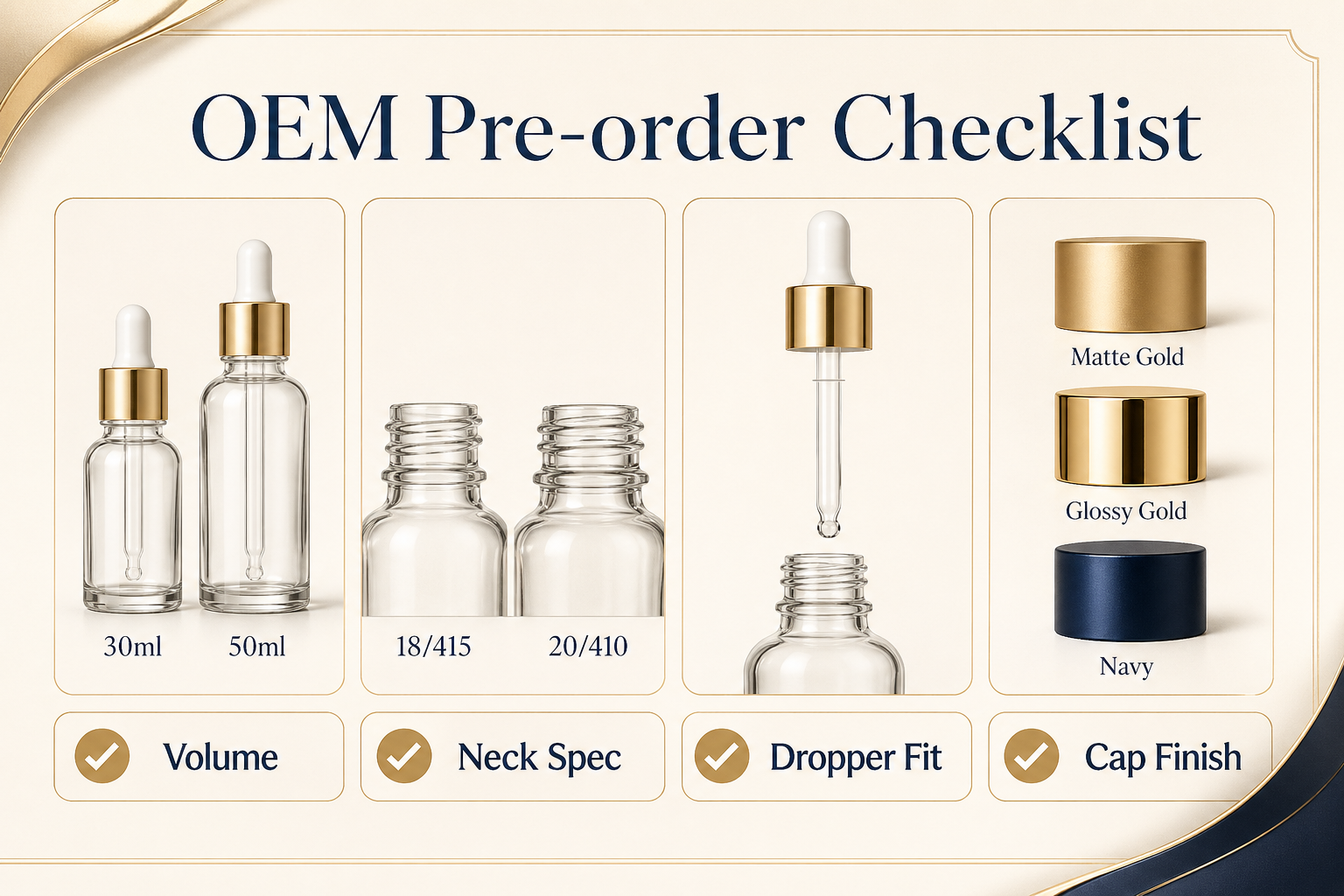
- Mistake 3 — Verifying dropper compatibility too late: 18mm and 20mm necks are not interchangeable. With 18/415 typical for 30ml and 20/410 typical for 50ml, dual SKUs almost always require two separate dropper components. Quote them as two distinct line items, not one.
- Mistake 4 — Splitting MOQ too thin: ordering 5,000 units each of 30ml and 50ml on the first run usually leaves both lines slow-turning. Without sales data, concentrate the first PO on one capacity and add the second within 6 months once you see real velocity.
- Mistake 5 — Forgetting label and carton drawings differ: 30ml and 50ml have different label dimensions, secondary carton specs, and tray cutouts. Brands that quote bottles only and assume packaging will reuse one drawing typically end up running label and carton production twice.
6. Practical Starting Combinations by Brand Stage
Distilled from a decade of first-PO patterns, the combinations below are reliable starting points. They are not the only valid choices, but they minimize the risk of an avoidable second tooling cycle.
- Indie launch on a constrained budget: 30ml round bottle with an 18mm metal-collar dropper, single SKU. The 01S30-01 line is the canonical example. It keeps paid acquisition affordable while D2C order data accumulates.
- Premium positioning above $80 retail: 30ml square or signature design bottle plus a gold lorette dropper. Models like 02S30-03/04 and JWD Lumi Square 30 deliver strong social-content conversion thanks to a distinct silhouette.
- Daily hero SKU: 50ml round plus a 20mm standard dropper. Choose between 01S50-03/04/07/10/11 based on shoulder shape preference. This is the default for subscription, multi-brand retail, and pharmacy channels.
- Dual SKU launch (trial + hero): use a series that already offers paired 30/50 bottles, such as JWD Lumi Square 30 + 50 or JWD Lumi Round 30 + 50. Shared design language compresses packaging design time and reduces the second-PO lead time.
- Refill-ready EU launch: 50ml hero bottle plus a 30ml refill cartridge. Under PPWR, a clearly communicated refill mechanism becomes a shelf-level differentiator and an on-pack story that resonates with retailer buyers.
7. Capacity Is a Strategy Decision, Not a Product Decision
30ml and 50ml are not just sizes — they are vehicles for entirely different purchase decisions. Once a brand evaluates them against channel mix, AOV, repurchase cycle, inventory turnover, and ad ROAS together, the right answer usually emerges. The safest sequence we see in practice is to launch with one capacity, accumulate real sell-through data, and expand into a dual SKU on the second purchase order.
To map specific viscosity and formula behavior to bottle and dropper combinations, see our formulation-to-packaging guide. For full neck-and-dropper compatibility on every SKU in our cosmetic glass packaging lineup, browse the components & anatomy guide. The complete 30ml and 50ml drawings — including JW OGE 50 and JWD Lumi Square/Round series — are listed in the product catalog. For lead times, MOQ, and quotes on serum bottle manufacturing, send a brief and target launch date through our contact page and we typically respond within one to two business days.

