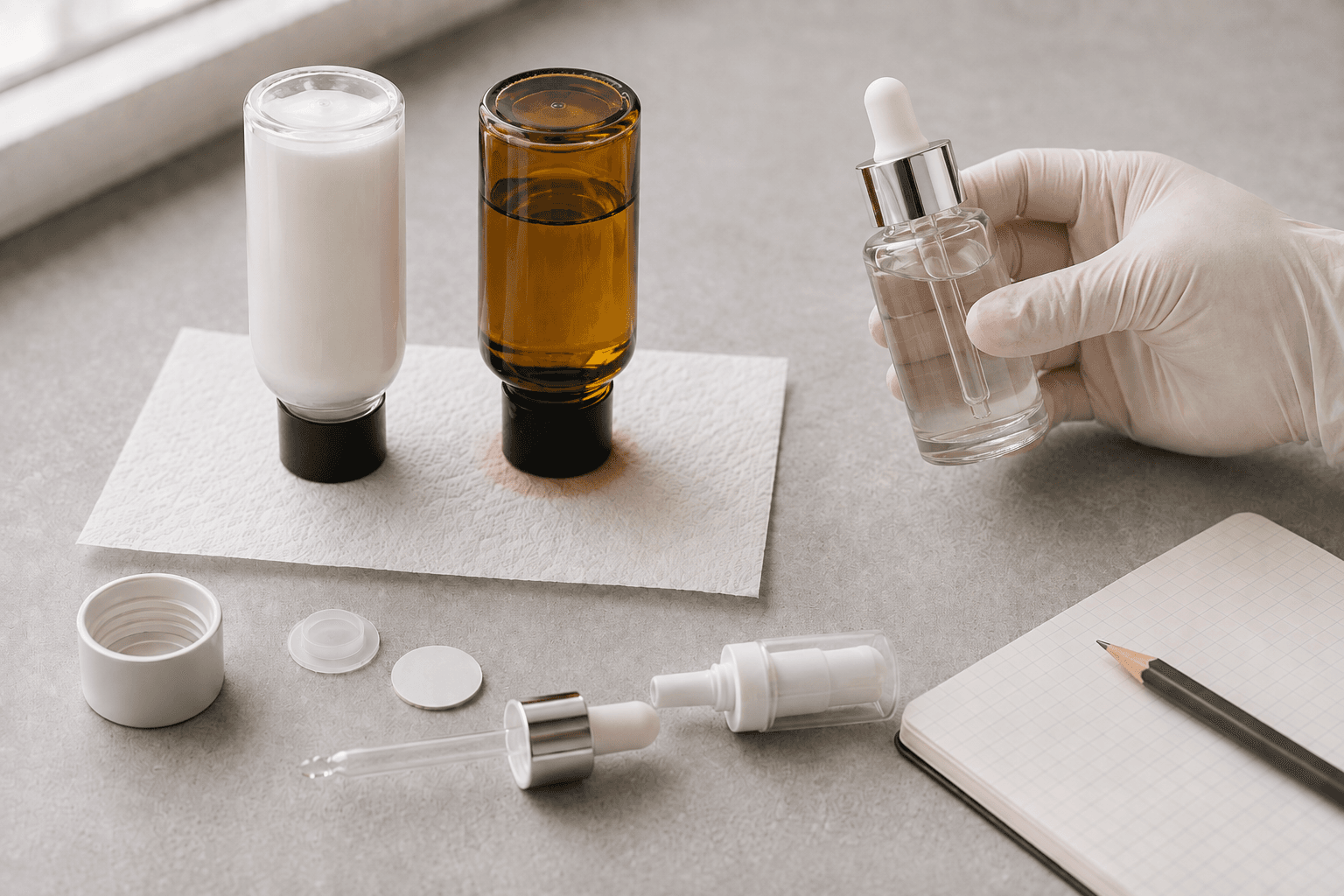
Plan and record cosmetic glass complete-pack compatibility reviews, and separate package and formula observations from formal safety and regulatory conclusions.
This guide is for a brand or product developer that already has a candidate pack. It does not recommend a container for a formula. Passing a specification test for the glass body alone does not establish that the whole package suits a particular formula; the scope here is only what to review and how to record it from a complete-pack perspective.
Why passing a glass body spec test does not prove complete-pack compatibility
A glass body is judged pass or fail within its own spec range: fill volume, neck finish, color, surface treatment. But in an actual product, what touches the formula is never the body alone. It is the body together with the closure, the liner or gasket, the rubber or plastic parts of a pump or dropper where applicable, printed or coated decoration, and, above all, the actual formula that gets filled in. The interactions that happen when all of these are present together do not show up in a body-only test.
Cosmetics Europe's 2019 packaging information-exchange advisory document names three factors through which the combination of packaging material, formulation, and contact with the external environment can affect finished-product safety: interaction between the packaging material and the product, barrier properties, and substance migration. The document itself states that there is no legal obligation to collect this information in any specific way, and it is explicit that it does not provide a safety-assessment methodology; it only covers the exchange of information a safety assessor needs to make that judgment.
In Korea, the Korea Cosmetic Industry Association distributes a reference document on cosmetic container test methods. That document is an industry reference on test methods, and it should not be treated as a legal requirement that every brand must follow without exception. Both documents offer a reference framework for what to check, but neither fixes a universal duration, temperature, sample count, torque value, or migration limit. This article does not set such universal numbers either; instead, it lays out the checklist items and record structure a brand should build for itself.
Role boundaries: what the packaging supplier, the brand or OEM/ODM, and the qualified assessor each do
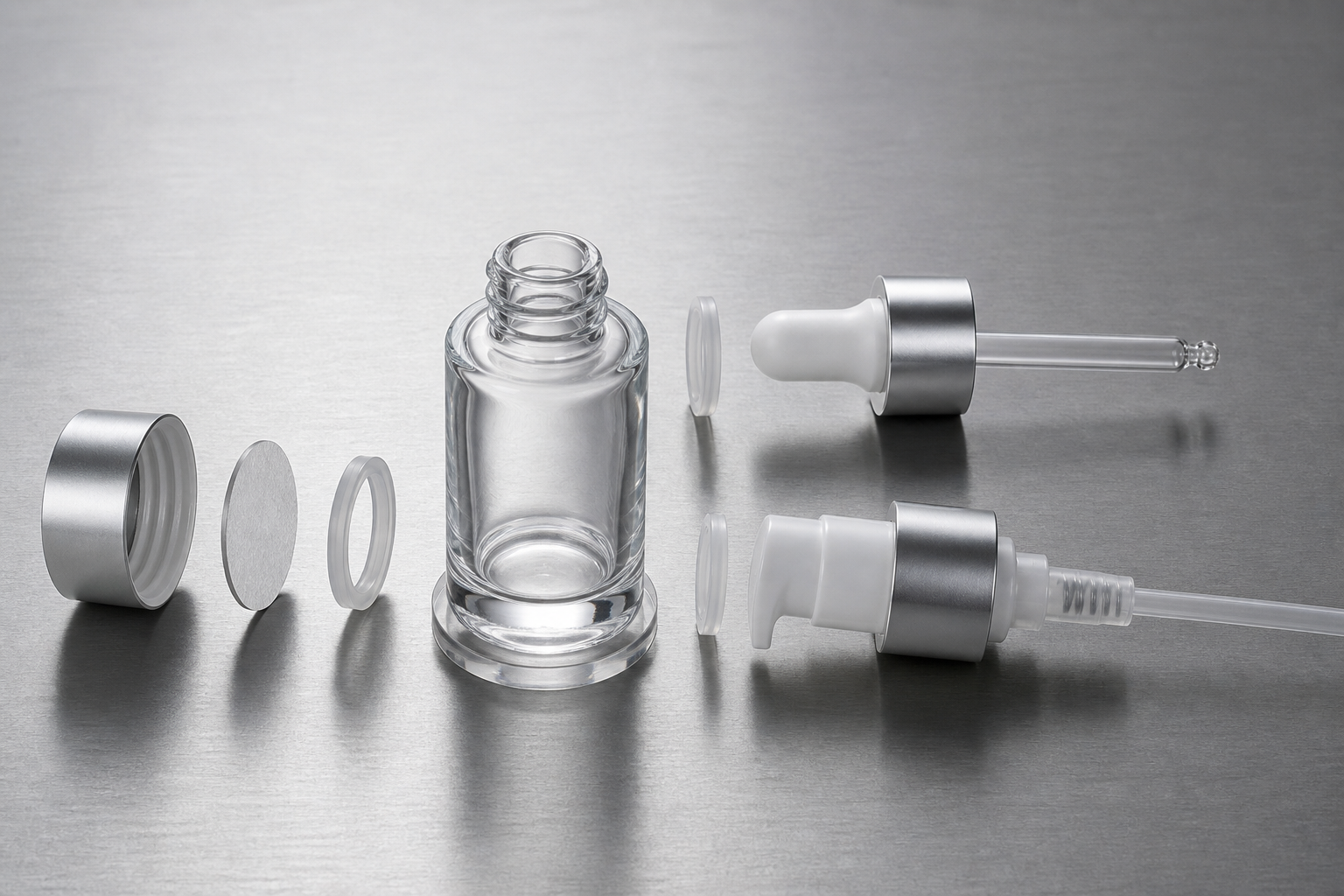
Before starting a complete-pack review, it helps to separate who is responsible for what. The packaging supplier's role is to provide specifications and physical samples for the candidate glass body, closure, liner, and pump or dropper. The supplier is responsible for the accuracy of the dimensions and materials listed on the spec sheet and for whether the candidate parts actually exist, but the supplier alone cannot determine whether that combination matches a specific brand's formula.
The brand or OEM/ODM is the party that defines the actual formula composition, the review plan, and what will count as acceptance criteria. The sample matrix and observation log described in this article exist to support the brand at this stage, designing that review plan and organizing what gets observed.
Areas that require a formal conclusion, such as shelf life, stability, microbiological or preservative-efficacy performance, toxicology or migration, regulatory compliance, and finished-product safety, belong to a qualified test lab or safety assessor. The records this article describes only prepare the observational evidence to hand over for that formal assessment; they do not substitute for a formal conclusion themselves.
Designing a sample matrix: what to record so it holds up as evidence later
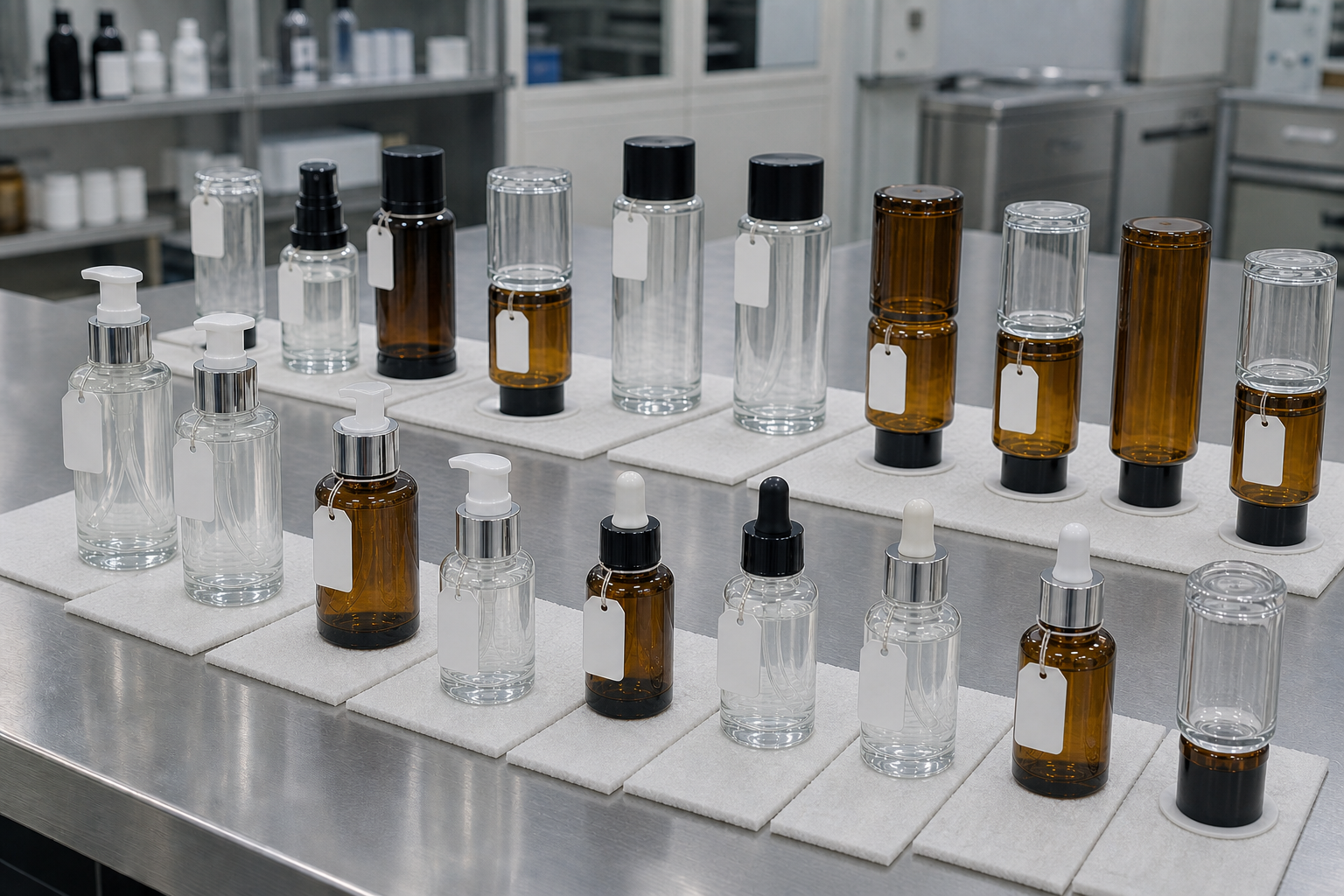
Building a sample matrix like the one below before starting a review lets you trace later which sample was observed under which conditions. For anything not yet decided, mark it explicitly as undecided rather than leaving the cell blank; that improves the reliability of the record. It is worth listing every contact component, closure, liner or gasket, pump or dropper, and decoration, without leaving any out.
| Sample ID | Formula/batch | Bottle spec/lot | Contact components | Finish | Fill/closure condition | Planned observation point/condition | Acceptance owner |
|---|---|---|---|---|---|---|---|
| GC-01 | Formula A / batch undecided | Spec confirmed, lot undecided | Screw cap, PE liner, no pump, no decoration | Standard finish | Manual fill, room-temperature closing | Observation points and conditions defined in the brand/OEM/ODM's scoped protocol | Brand QA owner (name undecided) |
| GC-02 | Formula A / batch undecided | Same spec, lot undecided | Screw cap, aluminum liner, no pump, no decoration | Standard finish | Manual fill, room-temperature closing | Observation points and conditions defined in the brand/OEM/ODM's scoped protocol, same protocol as GC-01 | Brand QA owner (name undecided) |
| GC-03 | Formula B / batch undecided | Spec and lot both undecided; needs supplier confirmation | Pump (dip-tube), liner undecided, silkscreen decoration | Silkscreen print finish | Condition undecided | Undecided, observation plan not yet set | No owner assigned |
Observation-decision log: separating packaging-function, formula, and formal conclusions

Mixing all observations into a single list makes it hard later to tell whether something was a packaging issue, a formula issue, or an already-reached formal conclusion. Keep three separate categories.
- Packaging-function observations: leakage, closure fit and dispensing performance, visible change in a component or decoration.
- Formula observations: discoloration, separation, viscosity change, and similar changes on the formula side. At this stage, record the fact only; do not yet decide whether packaging or the formula itself is the cause.
- Formal conclusions: stability, microbiological or preservative-efficacy performance, toxicology or migration, and regulatory compliance conclusions reached by a qualified lab or assessor. If not yet performed, mark it explicitly as "assessment pending" or "assessor confirmation needed."
Keeping these three categories separate reduces the temptation for an observer to declare safety on their own, and it leaves a clear record of which items have not yet been handed to a formal assessment.
A hypothetical example: comparing one controlled variable, the liner material
The following is not an actual test result. It is a hypothetical example built only to show the record structure. Assume the bottle body, cap, and formula are kept identical, and only the liner material is varied between two candidates: PE and aluminum.
Hypothetical observation: both samples showed no leakage and normal closure fit at the observation points defined in the brand/OEM/ODM's scoped protocol. However, only the sample with the aluminum liner showed a faint color change on the liner surface.
This result alone cannot tell you whether the color change came from an interaction between the formula and the liner material, or from a visual difference caused by lighting or photography conditions. When a result is ambiguous like this, do not immediately declare it "safe" or "unsuitable." Move to the next actions instead.
- Re-observe under the same conditions with more observation points and more samples.
- Separate whether the color change is a surface change in the liner itself or a result of the formula soaking into it.
- If needed, commission a migration analysis from a qualified test lab.
- Decide, against the brand's defined acceptance criteria, whether to proceed, hold, or re-review, and record the basis for that decision in the observation-decision log.
What this review does not cover
The sample matrix and observation-decision log described here support screening and record-keeping for a complete pack, including a cosmetic glass container. They do not substitute for conclusions on the following:
- Shelf life or stability conclusions for the formula
- Microbiological safety or preservative-efficacy assessment
- Toxicological evaluation or quantitative migration determinations
- Final determination of regulatory compliance
- Finished-product safety certification
These belong to a qualified test lab or safety assessor working separately from this record. The quality reference guide is also written with this same boundary in mind.
Why isn't checking the glass body spec alone enough?
A body spec only covers the body's own dimensions and material. It does not cover the interaction that appears once the closure, liner, pump or dropper, decoration, and actual formula are all present together. That is exactly why a complete-pack review is needed.
Does the hypothetical example mean the result is actually safe?
No. The example above only shows the record structure; it is not an actual test result. Use it only to see how to decide the next step when a result is ambiguous.
Next step: verifying the sample matrix on physical samples
Everything laid out here is still a plan on paper; it is only complete once it is checked against physical samples that carry the candidate components and the actual formula. If you want to plan that next step, see the sample verification process guide.
If you need to confirm package specifications or request candidate samples, reach out through the JeongwooCos contact page. JeongwooCos's role is to provide package specifications and candidate samples; the actual formula plan, acceptance criteria, and formal assessment remain the responsibility of the brand and the relevant qualified specialists.

